The Card System
Six Card Types. One Living Archive.
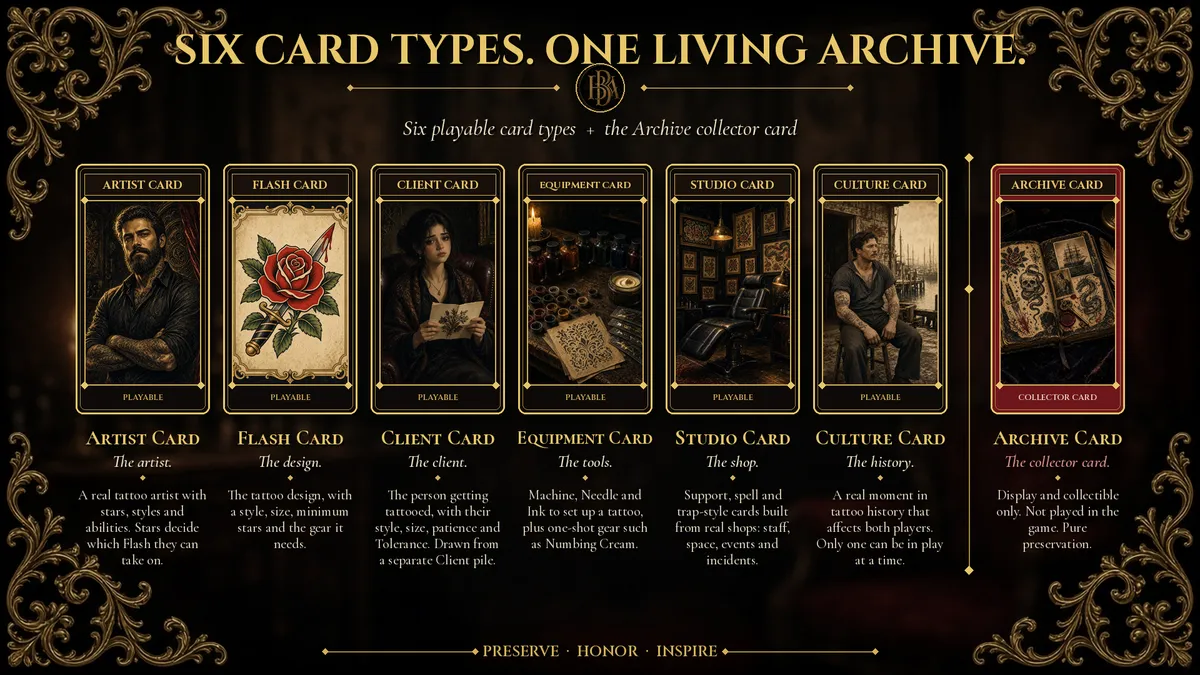
Six card types. One living archive.
Black Book Archives documents tattoo culture through six interconnected categories of playable cards, plus a collectible Archive card;
Artists. Flash. Clients. Culture. Equipment. Studios. Plus the Archive collector card, found in booster packs and made purely for collecting.
Each card preserves one part of tattooing, while together they create a growing physical and digital record of the culture.
All our cards form the foundation of the Black Book Archives trading card game, except one that exists purely for preservation.
Every card has a purpose. Every subject has a story.
The archive grows with every release.
Artist Cards
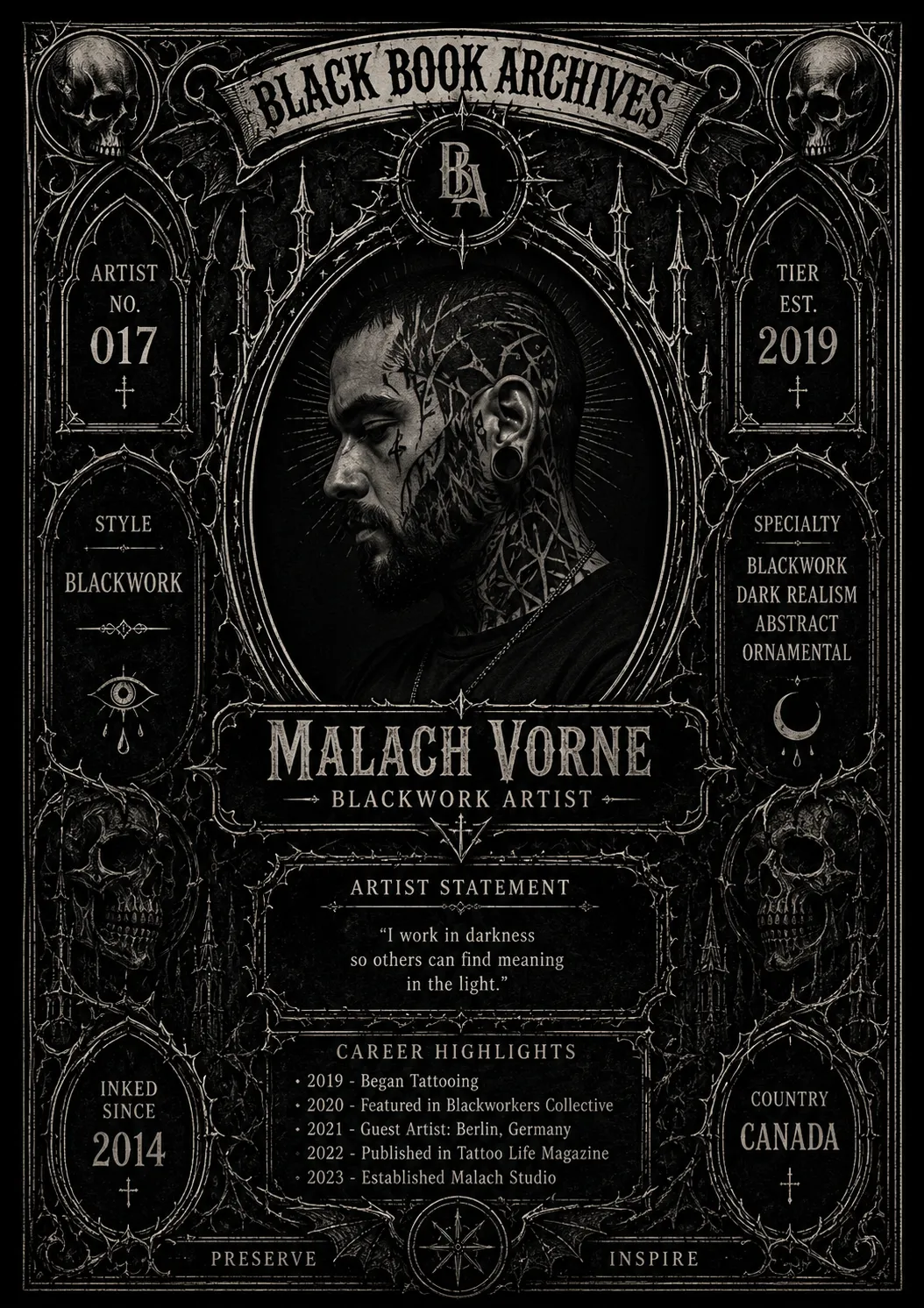
Artist Cards document the tattooers behind the work: their origins, specialties, philosophies, influences and excellence to the craft.
Each Artist Card is visually designed to reflect the artist's primary style and identity. A traditional tattooer should not feel visually identical to a fine-line artist, a blackwork specialist, or a color-realism artist.
Through the Black Book Archives website, collectors can explore participating artists in greater depth, discover their work, learn about their careers, and find the Flash Cards associated with their collection.
In The Game
Your Artists determine what your studio is capable of doing.
Different Artists specialize in different tattoo styles and are better suited to particular Flash Cards and Client demands.
Build a specialized studio around a particular style or create a diverse roster capable of handling a wider range of clients.
THE ARTIST DEFINES THE CAPABILITY OF YOUR STUDIO.
Flash Cards
Each card celebrates a tattoo design and the artist who created it, allowing collectors to discover artwork and artists they may never otherwise encounter.
For artists, Flash Cards create another way for artwork to travel beyond the studio, convention booth, social-media feed, or personal website.
For collectors, they offer an accessible way to own, preserve, and appreciate tattoo artwork—even if that artwork never becomes part of their own skin.
Every Flash Card connects back to its artist and, where applicable, to deeper information within the Archive.
In The Game
Choose the right Artist. Equip them properly. Match the Flash to the Client's demand. Complete the session and earn Respect.
Client Cards
Beyond the gorgeous vogue photography, Client Cards explore the relationship between the artist and client through stories, meaning, and connection through time.
The series features lifelong collectors, tattooed models of all genders, first-time clients young and old; all sorts of people from every corner of tattoo culture.
Some of tattooing's greatest work exists because the right client found the right artist—and gave them the freedom to create something extraordinary.
In The Game
Each Client has specific requirements and limitations, including:
Style Demand
Size Demand
Completion Reward
Time Limit
Tolerance Limit
Failed Session Consequence
The challenge is not simply to complete a tattoo.
It's to bring together the right Client, Artist, Flash, and Equipment before time runs out.
THE CLIENT CREATES THE DEMAND.
Culture Cards
Culture Cards document the movements, eras, traditions, conventions, trends, and moments that have shaped tattooing.
They explore not only what happened, but also why it mattered.
A Culture Card might document a historical era, an influential convention, the resurgence of a style, a regional movement, a changing social attitude toward tattooing, or another cultural force that affected the craft.
The goal is to give collectors enough context to understand that tattooing is not a collection of disconnected images.
It is a living culture shaped by time, place, people, and circumstance.
In The Game
Culture Cards modify the environment in which the game is played.
Certain cultures may favor particular:
Styles
Artists
Strategies
Studio configurations
A Culture Card can create opportunities, limitations, or advantages that change how players approach the game.
CULTURE CHANGES THE ENVIRONMENT.
Equipment Cards
Equipment Cards document the machines, needles, cartridges, inks, and other tools that make tattooing possible.
The category explores equipment from both historical and contemporary perspectives: how tools developed, why they changed, who made them, where they came from, and how they affected the way artists work.
Everything from historically significant machines and methods, personal machines built and tuned, to modern tools that represent the continuing evolution of tattoo technology.
The goal is to document the role equipment plays in the history and practice of tattooing.
In The Game
The correct setup helps an Artist perform appropriate Flash efficiently and maximize the Respect earned from successful completion.
Studio Cards
Tattoo studios are more than a workplace. They're creative environments, training grounds, communities, and sometimes landmarks within their local tattoo scenes.
Studio Cards document stories of studios that have stood the test of time, emerging studios creating new communities, and historically meaningful shops whose doors may no longer be open while their influence remains.
A Studio entry can also acknowledge the owners, operators, artists, managers, and other long-term contributors whose work helped shape its place in the community.
In The Game
Studio Cards act as support cards.
Depending on the card, a Studio may provide:
Passive Effects
Active Effects
Buffs
Debuffs
Protection
Strategic Modifiers
Duration-Based Effects
The right Studio can strengthen your Artists, improve your workflow, protect your strategy, or change how your side of the game operates.
THE STUDIO SUPPORTS THE OPERATION.
Archive Cards
Archive Cards are different from every other category in Black Book Archives.
They exist purely for preservation.
Archive Cards document historically and culturally meaningful material that may not fit into the other card types.
They're designed with greater freedom for historical presentation and ornamental detail.
They are intended to feel like miniature museum pieces: objects worth examining, reading, collecting, preserving, and displaying.
THE ARCHIVE CARD PRESERVES WHAT MUST NOT BE LOST.
In The Game
Archive Cards have no game function.
This card category exists purely for educational, historical and archival purposes.
Rarities
Every card tells you how rare it is. Look for the badge at the bottom centre of the card. It's a classic flash symbol, and its metal tells you the tier.






Common and Uncommon are the backbone of your deck: the machines, needles, ink and everyday shop moments that keep your stations running.
Rare cards change how you play a turn. Perma Rares are real threats your opponent has to plan around. Legendary Rares are the ones that make the whole table stop and look, and every one of them still has an answer.
Holo on every Rare and up
Every Rare, Perma Rare and Legendary Rare is printed holo. It's in the base set, in every pack and every starter deck, not saved for a special edition. If it shines, it's a Rare or better.
Blush Foil
Blush Foil is our rose-gold finish, made for alternate art. Every alt-art card in Black Book Archives is Blush Foil, and it carries its own rose badge, so you'll know one the moment you pull it.
Rarer doesn't mean pay-to-win
Holo, alt-art and special finishes make a card more collectible, never stronger. An alt-art version plays exactly like the original. Rarity follows how much a card changes the game, and the game stays balanced straight out of two starter decks.
First edition, printed once
Set One is printed once and never reprinted. Returning artists get new cards in later sets, so a Set One card stays a Set One card.
Preserve. Honor. Inspire.
Join the Founders List
Get Set One updates, Kickstarter news and founding artist announcements.
Stay Updated with the latest news in the Archives. Subscribe to our newsletter for updates and exclusive offers to take part in ink history. Join our community today!
Quick Links
Resources
© Black Book Archives 2026 All Rights Reserved.