
Blogs
Home — Blogs
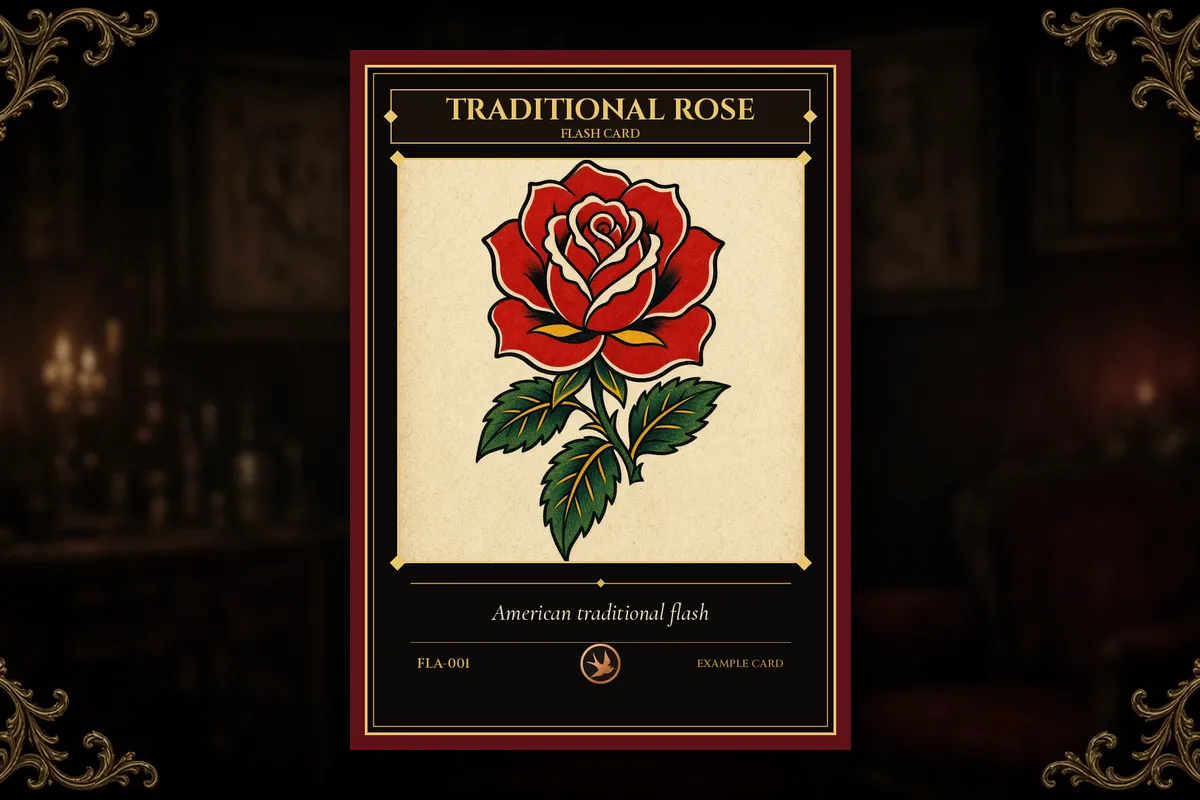
Traditional Rose | Flash Card FLA-001
Traditional Rose
Example entry. The artist and story behind this flash are fictional, created to show what Black Book Archives entries will look like. Real Founding Artists' flash will replace this entry, with their consent. The history described below is factual.
Archive record
Card ID: FLA-001
Card type: Flash
Style / Subject: American traditional / Red rose
Status: Example entry
The Design
A single red rose in full bloom, three leaves, one stem. Bold black outline, solid red, a touch of yellow, green leaves with gold veins, and open skin left to breathe. It is one of the most tattooed images in the Western world, and it was built to be: readable across a room, and made to hold up for a lifetime.
The Artist and the Reason
This rose was drawn by Theresa "Tess" Kowalski (fictional), an American traditional tattooer working in Brooklyn, New York. Her grandfather, a merchant seaman, came home from the Pacific in 1945 with a rose and a banner reading "Mother" on his forearm. He kept the tattoo for sixty years. When he was dying and could no longer speak, Tess sat by his bed and traced the faded rose with her finger, the same way she had as a child.
She drew this flash the week after his funeral and has never changed a line. "He carried it so long it stopped being ink," she says. "It was just him. I wanted to give people the same chance to carry someone."
"A rose is how sailors said what they couldn't say out loud."
Why American Traditional
The style grew up in American tattoo shops that served sailors and servicemen, where work had to be done quickly and had to last. Bold lines, a limited palette and simple shading were not just taste; they held. Norman "Sailor Jerry" Collins (1911–1973), who worked on Hotel Street in Honolulu, is widely credited as one of the artists who defined American traditional. Bert Grimm (1900–1985), called the "grandfather of old school," tattooed across the country and is best known for his shop on the Pike in Long Beach, California, where he influenced a young Ed Hardy.
New York has its own chapter. In 1961 the city's Board of Health banned tattooing, citing a link to hepatitis. For thirty-six years the craft carried on in apartments and back rooms, until the City Council legalized and regulated it again in 1997. Every rose tattooed legally in New York today exists because people kept the tradition alive when it was against the law.
What the Rose Means
In tattooing, a red rose most often means love, devotion and remembrance. In the sailor tradition it often stood for a woman waiting at home, or one loved and lost, and it was frequently paired with a banner naming a mother or a sweetheart. The "Mother" and "Mom" banners became especially popular with servicemen during and after the Second World War. Thorns add the old lesson that love and pain grow on the same stem.
The Rose Across Cultures
Victorian England: Floriography, the "language of flowers," became a craze in the nineteenth century, letting people send feelings they could not say aloud. A red rose meant true love.
Ancient Rome: In Roman myth, Cupid gave a rose to Harpocrates, the god of silence, so the rose became a sign of secrecy. That is the root of the Latin phrase sub rosa, "under the rose," still used to mean in confidence.
Christianity: After the Roman Empire became Christian, the rose became a symbol of the Virgin Mary. The rosary takes its name from the Latin rosarium, a crown or garland of roses. The great round windows of Gothic cathedrals are called rose windows, and many are dedicated to Mary.
Persia: The rose, gol, is central to Persian poetry. Saadi's Gulistan (1258), one of the most influential works of Persian prose, is usually translated as "The Rose Garden." In the Persian ghazal, the love poem Hafez (c. 1325–1390) brought to its height, the rose's beauty draws the nightingale's song of longing.
England: After Henry VII won the crown at Bosworth in 1485, the Tudor rose joined the red rose of Lancaster and the white rose of York, ending what came to be called the Wars of the Roses.
In the Archive
One flower, carried by sailors, saints, poets and kings, then drawn again by a granddaughter in Brooklyn. That is what the Archive keeps: not just the image, but the hands it passed through.
Black Book Archives

Preserve. Honor. Inspire.

Join the Founders List
Get Set One updates, Kickstarter news and founding artist announcements.
Stay Updated with the latest news in the Archives. Subscribe to our newsletter for updates and exclusive offers to take part in ink history. Join our community today!
Quick Links
Resources
© Black Book Archives 2026 All Rights Reserved.